
How to Reverse Fatty Liver Naturally: What Actually Works

⏱ Quick Snapshot : 30-Second Read
How Common? About 1 in 3 adults have fatty liver, more than 60 million people in the US alone. Most don’t know, because it shows no symptoms until damage is done.
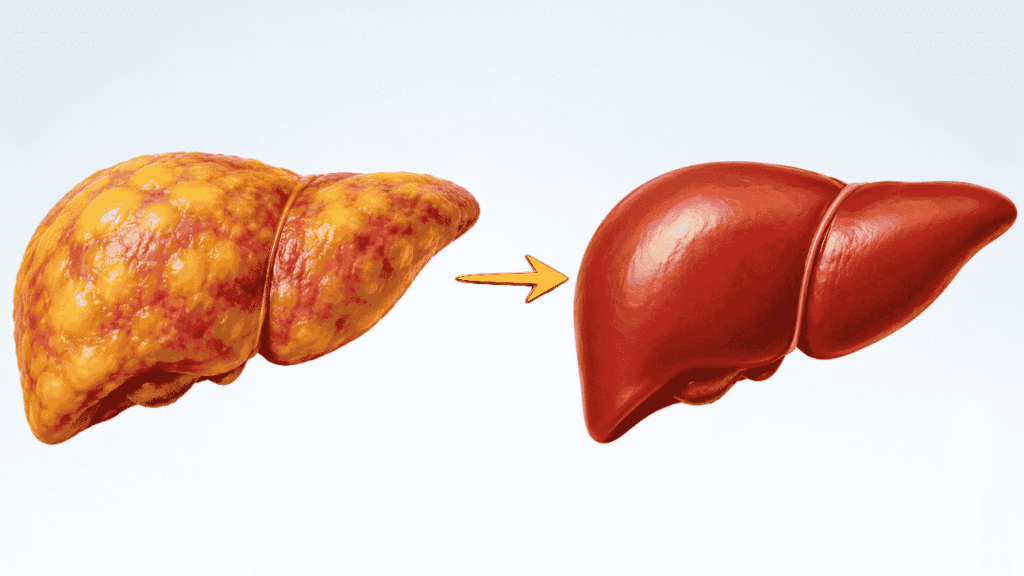
Why Care? Left alone, it can quietly scar the liver. But the crux of the problem is that a fatty liver usually harms you through your heart, not your liver.
What Reverses It? Losing just 5 to 10% of your body weight can reverse it. At 200 lbs, that’s about 10 to 20 lbs.
What Works? A small and steady calorie deficit, whole foods containing adequate macros and nutrients, paired with regular exercise, which drains liver fat even if the scale doesn’t move.
What Doesn’t? Detox teas, lemon water, apple cider vinegar, “liver support” supplements. Your liver is the OG detoxifier. So, the goal isn’t to clean it; it’s to stop hurting it.
Introduction
About 33% of adults have a fatty liver. That’s more than 60 million people in the United States alone. Most of them have no idea, because a fatty liver doesn’t show symptoms until the damage is extensive.
If left alone, it can quietly scar your liver and even raise your risk of liver cancer. But even more important is the fact that a fatty liver usually doesn’t harm you through your liver. It harms you through your heart.
But there is a bright side to this. One factor can reverse a lot of damage, and it’s less complicated than you might think: just 5 to 10% of your body weight. This is how much you’d need to lose to pull fat back out of your liver, calm the inflammation, and in many people, even reverse early scarring. So let’s answer the real question: why and how does losing such a small amount create such a big change inside your liver?
What’s Actually Happening in a Fatty Liver
Most people first hear “fatty liver” from a routine ultrasound, and no one really explains what it means. So let’s start there.
Here’s the first surprise: eating fat isn’t what puts fat in your liver. Fat builds up when your body takes in more energy than it can use, mostly from extra calories, sugar, and refined carbs. Your liver takes that surplus and stores it as fat, right inside its own cells.
That’s why a fatty liver almost never comes alone. It travels with the same group every time: visceral fat (the deep fat around your organs), insulin resistance, type 2 diabetes, high triglycerides, and extra weight around the middle. These aren’t random. They’re all the same underlying problem: too much energy coming in, and a body that’s stopped handling it well.
So when you picture a fatty liver, don’t picture something dirty that needs cleaning. Picture something overloaded. That one shift in how you see it changes everything about how you fix it.
Why Losing Just 5 to 10% Does So Much
So why does a little weight loss do so much? Because you’re not clearing out the liver. Rather, you’re shutting off the oversupply.
In one study, adults who lost about 10% of their weight saw their liver fat fall from around 19% down to under 5%. When researchers looked at why, they found the liver had simply stopped making so much of its own fat. No one detoxed it. They removed the excess energy, and the liver did the rest.
But why 5 to 10% specifically? Because each milestone unlocks something different:
- Around 5%: Your liver fat starts to drop.
- 7 to 10%: Inflammation starts to settle, which is what actually damages the liver over time.
- 10% or more: Something remarkable happens. In a landmark study, about 90% of people with the inflamed form of fatty liver saw it fully resolve, and roughly 45% saw their early scarring actually reverse.
Let’s put these numbers in perspective. If you weigh 200 pounds, 5% is just 10 pounds, and 10% is 20 pounds. The first 10 pounds is where the healing starts, and every pound after that helps even more.
But please keep in mind that this isn’t a race. Losing weight too fast can actually be very hard on the liver and set you back. Slow and steady, about a pound a week, is what works and what can be maintained.
Exercise Works, Even Without the Weight Loss
What if you’re doing everything right and the scale just won’t move? Many people end up quitting, right before the payoff.
But the cogs are working on the inside, and exercise pulls fat out of your liver even when your weight stays the same. In a review of 14 studies, people who exercised were about three and a half times more likely to get a real drop in liver fat than people who didn’t, and that benefit held up independent of weight loss. So if you’ve been exercising and haven’t seen the scale budge, keep going. The change is already happening in your liver, where it counts.
So let’s take out the guesswork and give you a prescription instead. Start with a brisk walk, 30 minutes, five days a week, at a pace where you’re a little breathless but can still talk. This alone drains liver fat. Then gradually add strength training twice a week. Muscle is where your body burns sugar, so it goes straight at the insulin resistance underneath all of this.
What You Should Actually Eat
So, what should you be eating? I’m going to skip the “top 10 liver superfoods” list, because that’s not how this works. There’s no magic food that cleans your liver.
The goal is a small, steady calorie deficit, maybe even a few hundred calories a day. But how you get there matters too, and for a fatty liver, one eating pattern stands above the rest: the Mediterranean diet.
The Mediterranean diet isn’t a strict branded plan. All it recommends is vegetables, beans and lentils, whole grains, fruit, fish, nuts, and olive oil as your main fat. In studies, this pattern lowered liver fat and improved insulin sensitivity even when people didn’t lose weight, with liver fat dropping by nearly 40% in some research. And it protects your heart, which, remember, is the real danger here.
What to Cut, in Order of Impact
- Sugary drinks first. Soda, juice, sweet coffees. They hit the liver hardest.
- Added sugar and refined carbs next, like white bread and pastries.
- Ultra-processed food in general.
- Alcohol, if you drink, because it goes straight to the liver.
One bonus you might like: if you drink coffee, three or more cups a day is linked to less liver fat and less scarring; just keep it black.
And here’s the fact I want you to know. Your liver already detoxifies your body; that’s its job. You don’t need to detox your liver. So you can skip the detox teas, the lemon water, the apple cider vinegar, and the “liver support” supplements. They do nothing for this. The goal was never to clean the liver. It’s to stop overloading it.
The Bigger Question: Do You Have Scarring?
Now the part most videos skip, and it’s the one that actually decides your future. Having fat in your liver matters. But what really matters is whether that fat has started to cause scarring. The medical word is fibrosis.
The path goes in four steps: fat, then inflammation, then scarring, then cirrhosis. Most people never go all the way down that road, but you want to know where you stand, because scarring is silent. People with advanced scarring are roughly two and a half times more likely to die early than those caught at the fat stage.
Here’s something important: the ultrasound that found your fatty liver can see the fat, but it can’t tell you whether you have scarring. For that, you need two simple things. First, a score called FIB-4, which your doctor calculates from your age and three numbers you probably already have (AST, ALT, and platelets). If that score is high, the next step is a FibroScan, a quick, painless scan that measures how stiff your liver is. A soft liver is healthy; a stiff one means scarring.
You don’t need to memorize any of this. You just need to ask your doctor one question: Do I only have fat, or do I have scarring?
Your 4-Step Action Plan
1. Lose the First 5%, Slowly
If you’re carrying extra weight, aim to lose the first 5%, lost slowly.
2. Move, Even If the Scale Doesn’t Budge
Walk, then add strength training. Your liver responds even before the scale does.
3. Eat the Mediterranean Way
Build meals around vegetables, beans, whole grains, fish, nuts, and olive oil, and cut sugary drinks first.
4. Ask Your Doctor for a FIB-4 Score
Especially if you have diabetes, obesity, or extra weight around the middle. It’s worth adding to your list of health checks after 40.
The Bottom Line
That’s it. No cleanse, no supplement, no detox. Because here’s the whole truth about a fatty liver: you don’t reverse it with a cleanse. You reverse the conditions that made your liver store the fat in the first place.
Frequently Asked Questions
Can a fatty liver really be reversed?
Yes, especially when caught early. Losing 5 to 10% of your body weight can clear much of the fat, calm inflammation, and in many people even reverse early scarring. The earlier you act, the more completely it tends to reverse.
I’m not overweight. Can I still have a fatty liver?
Yes. Though it’s more common with extra weight, “lean” fatty liver exists, often tied to insulin resistance, high sugar intake, or genetics. The same steps (less sugar, Mediterranean-style eating, and exercise) still help, so it’s worth discussing with your doctor.
Do liver detox teas or cleanses work?
No. Your liver already detoxifies your body on its own. Detox teas, cleanses, and “liver support” supplements don’t remove liver fat, and some can even be harmful. The real fix is reducing the overload, not cleaning the organ.
How long does it take to see improvement?
Liver fat can start dropping within a few weeks to months of consistent changes. Bigger improvements, like calming inflammation and reversing scarring, take longer and track with how much weight you lose and how steady you are. Slow and steady wins here.
Is a fatty liver dangerous if I feel fine?
It can be, because it’s usually silent. The bigger risks, heart disease and, in some people, liver scarring, build quietly without symptoms. That’s exactly why it’s worth addressing early and asking your doctor whether you have scarring.
Medical Disclaimer
This article is for educational purposes only and is not a substitute for professional medical advice, diagnosis, or treatment. If you’ve been told you have a fatty liver, or have diabetes, obesity, or other risk factors, talk to a qualified healthcare professional about testing (including scarring) and a plan that’s right for you. Never start, stop, or change a medication on your own.
References
- Vilar-Gomez, E., Martinez-Perez, Y., Calzadilla-Bertot, L., Torres-Gonzalez, A., Gra-Oramas, B., Gonzalez-Fabian, L., … Romero-Gomez, M. (2015). Weight loss through lifestyle modification significantly reduces features of nonalcoholic steatohepatitis. Gastroenterology, 149(2), 367–378. https://doi.org/10.1053/j.gastro.2015.04.005
- Marchesini, G., Petta, S., & Dalle Grave, R. (2016). Diet, weight loss, and liver health in nonalcoholic fatty liver disease: Pathophysiology, evidence, and practice. Hepatology, 63(6), 2032–2043. https://doi.org/10.1002/hep.28392
- Rinella, M. E., Neuschwander-Tetri, B. A., Siddiqui, M. S., Abdelmalek, M. F., et al. (2023). AASLD Practice Guidance on the clinical assessment and management of nonalcoholic fatty liver disease. Hepatology, 77(5), 1797–1835. https://doi.org/10.1097/HEP.0000000000000323
- Stine, J. G., DiJoseph, K., Pattison, Z., Harrington, A., Chinchilli, V. M., Schmitz, K. H., & Loomba, R. (2023). Exercise training is associated with treatment response in liver fat content by magnetic resonance imaging independent of clinically significant body weight loss in patients with nonalcoholic fatty liver disease: A systematic review and meta-analysis. American Journal of Gastroenterology, 118(7), 1204–1213. https://doi.org/10.14309/ajg.0000000000002098
- Cleveland Clinic. (n.d.). Fatty liver disease (hepatic steatosis). https://my.clevelandclinic.org/health/diseases/15831-fatty-liver-disease
- Zelber-Sagi, S., Godos, J., & Salomone, F. (2016). Lifestyle changes for the treatment of nonalcoholic fatty liver disease: A review of observational studies and intervention trials. Therapeutic Advances in Gastroenterology, 9(3), 392–407. https://doi.org/10.1177/1756283X16638830
Sign Up to Our Newsletter
Be the first to know the latest health updates.

