

Heart block- Do you need a pacemaker?


Mr. Anderson, a 58-year-old schoolteacher, complains of dizziness. He has been experiencing fatigue and chest pain since. He has a history of hypertension and has been taking his medication regularly. His general health is otherwise good. He is worried that a heart block Holter monitor will show he needs a pacemaker.
What is Heart Block?
It is a problem in the electrical system of the heart. The heart has four chambers and four heart valves, which regulate the blood supply in the body normally. Typically, the electrical signal starts from the sinoatrial node (SA node) at the right atrium to the atrioventricular node (AV node). From the AV node, it goes to the Bundle of His, and ultimately, it extends into the right and left ventricles. Heart blocks occur when these electrical signals, which move from top to bottom, are disrupted or delayed.
There are three types of heart block, from first-degree heart block, which is the mildest, to third-degree (complete heart block), which is the most severe type.
What Are The Symptoms of Heart Block?
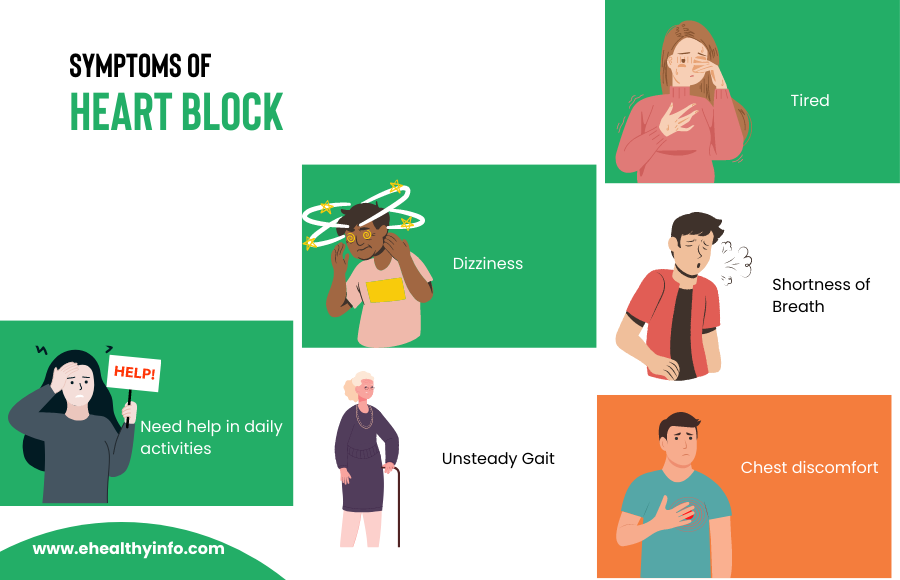
- Tiredness and fatigue
- Dizziness or lightheaded, feeling of fainting
- Unsteady gait, shortness of breath, tiredness, and fatigue.
- You may need help in doing day-to-day activities.
- You may have shortness of breath.
- Chest discomfort
What Are The Causes of heart Block?
- Age: Heart block is more common in older adults (>65 years).
- Sex: Heart block is more common in males.
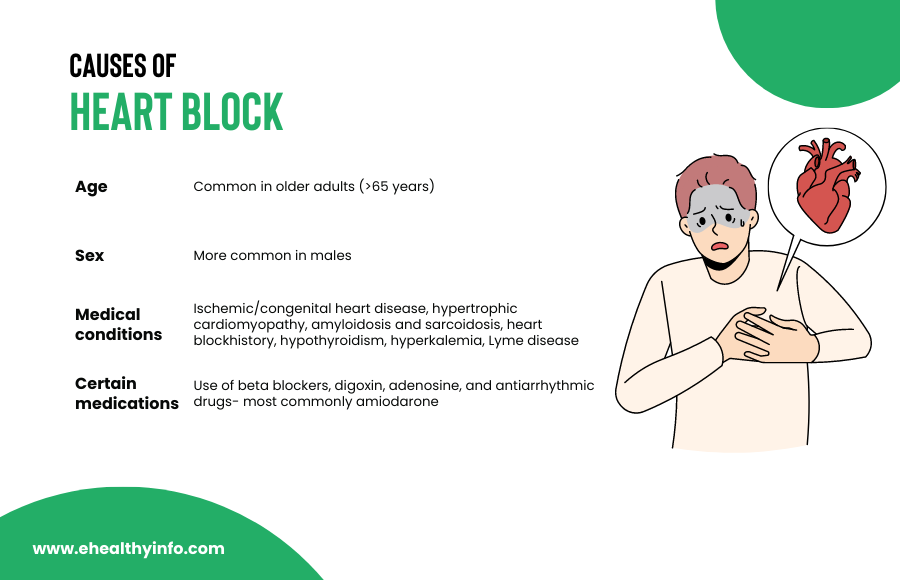 Age: Heart block is more common in
Medical Conditions and Medicines
- Certain medical conditions: If you have ischemic heart disease, hypertrophic obstructive cardiomyopathy, amyloidosis and sarcoidosis, congenital heart disease, family history of heart block, hypothyroidism, hyperkalemia, Lyme disease.
- Use of certain medications: You are at higher heart block risk if you are on beta blockers, digoxin, adenosine, and antiarrhythmic drug, most commonly amiodarone.
What Are the Types of Heart Block?
There are mainly three types of heart block, first-degree, the mildest type, and third-degree, the most severe type.
1. First-Degree Heart Block
It usually doesn’t have any symptoms. All electrical impulses reach the ventricles despite being slowed through the conduction system. Well-trained athletes may have first-degree heart block. Some drugs can also bring on this syndrome. First-degree heart block typically does not require any treatment.
2. Second-Degree Heart Block
- In second-degree heart block, the electrical impulse doesn’t reach the heart’s lower chamber, and the heart may escape beats and become irregular. You may feel dizzy, faint, or have other symptoms.
- This may be serious in some cases.
3. Third-Degree Heart Block
- In this type, the upper and lower chamber of the heart doesn’t beat in a synchronized manner.
- The upper and lower chambers do not beat sequentially (one after the other) as they ordinarily do, and the lower chambers beat at a significantly slower rate.
- The heart is unable to supply the body with enough blood. Breathlessness and dizziness may result from this.
- This is an emergency that needs medical help right away.
Heart Block Holter Monitor: How Will Your Doctor Diagnose It?
- Your doctor will talk to you about the symptoms that a heart block could cause.
- Your doctor will do ECG or heart block Holter monitor tests to look for any irregularities in the heart.
- It’s crucial to record your activities and symptoms accurately while using a heart block Holter monitor; therefore, keep a journal. Write down the time of day they started and what you did in your diary if you experience symptoms like chest discomfort, shortness of breath, irregular heartbeats, or dizziness. The variations in your ECG captured by the Holter monitor will be compared to the entries in your diary. Sometimes your doctor also may ask you to wear a heart block Holter monitor for 24-48 hours to monitor any irregularities.
How Will Your Doctor Treat Heart Block?
Treatment depends upon the type of heart block. Firstly, your doctor finds out about the kind of heart block.
- If you don’t have any severe symptoms, you need regular follow-ups with your doctor.
- Your doctor may prescribe a wearable device, like a heart block Holter monitor, to monitor your heart’s electrical activity, even at home.
Do All People With Heart Block Need a Pacemaker?
- If you have second or third-degree heart block, you may need a pacemaker for heart block. It is a small battery-operated device that senses when your heart is beating too slowly or irregularly. It sends a signal to your heart which will correct the heart’s pace.
A heart block Holter monitor can show your doctor whether a pacemaker is the right next step.
Questions For Your Doctor
- What is the cause of my heart block?
- What is the type of heart block?
- What therapy or medication will help me?
- Do I need to stop any medications?
- Do I need a heart block Holter monitor or other wearable device to monitor my heart at home?
- When should I visit the emergency room or call 911 for heart block?
- How long will I wear a Holter monitor for heart block?
- Is my first-degree heart block serious, and does it need treatment?
References
- American Heart Association. (n.d.). Arrhythmia. https://www.heart.org/en/health-topics/arrhythmia
- Heart Rhythm Society. (n.d.). Heart block. UpBeat.org. https://upbeat.org/heart-rhythm-disorders/heart-block
- MedlinePlus. (n.d.). Heart block. National Library of Medicine. https://medlineplus.gov/ency/article/007658.htm


